
What could we do together that none of our organizations could do alone?
The Good Growth Company brought people together on November 5 at Toronto’s Centre for Social Innovation to explore that question at the Together for Impact Summit.
The room included nonprofit founders and executive directors, program managers, fundraisers, philanthropy advisors, entrepreneurs and consultants. Some worked directly with young people, newcomers and families. Others brought experience in health, the arts, community development and funding. That mix gave people a chance to hear how the same partnership looks to the person funding it, the team delivering the program and the community it serves.
Attendees highlighted the workshops, the relevance of the panel and the chance to meet people whose work connected with their own. One attendee went through nearly two fountain pens’ worth of ink taking notes and left feeling more confident about building lasting partnerships with peers and donors. Others said they wanted even more time to learn from one another.
Whether you joined us in Toronto or are catching up afterward, here are a few takeaways to bring back to your team.
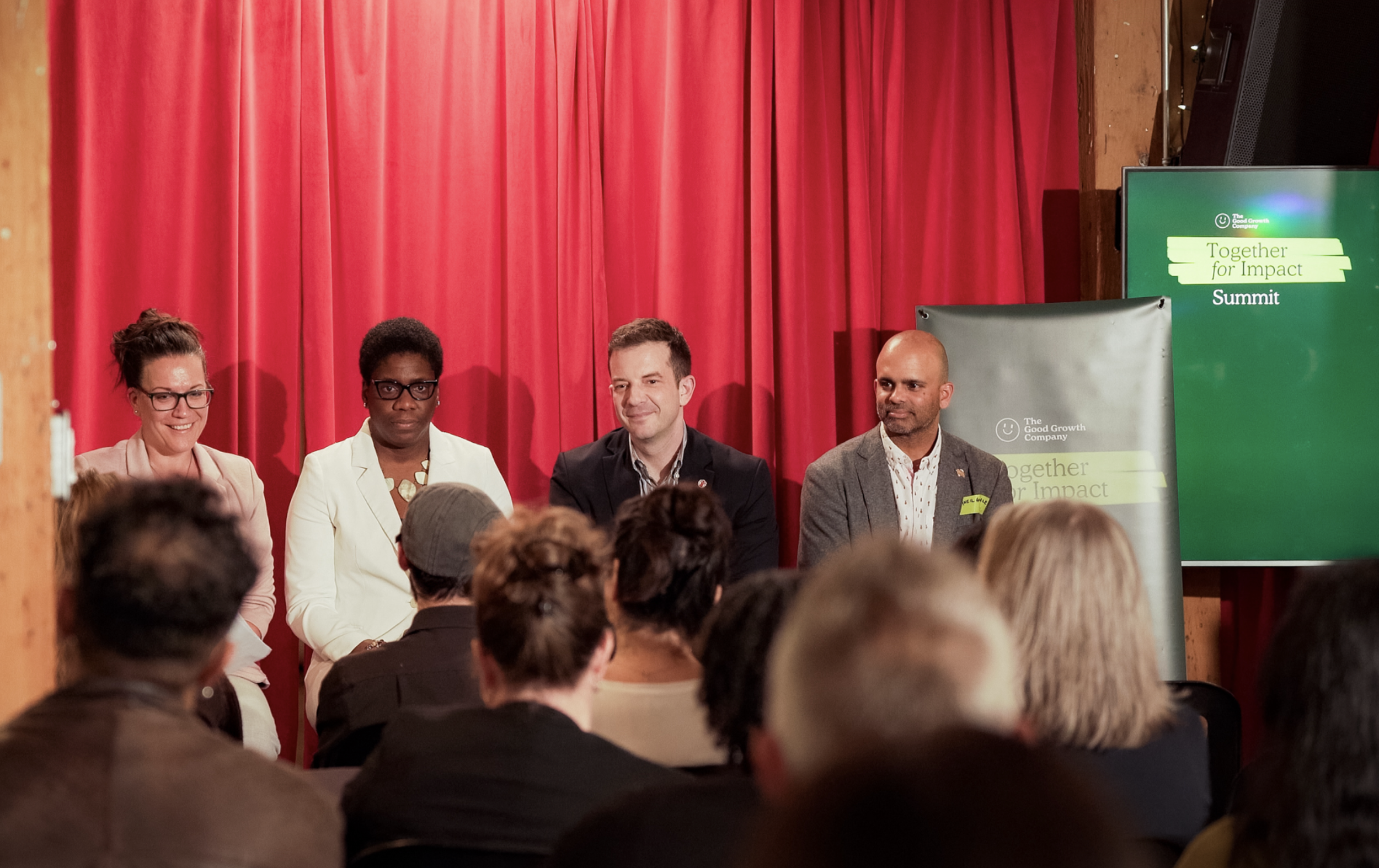
The Collaboration Imperative Panel at the Together for Impact Summit. Photo by Javon Martin, November 5, 2026.
10 takeaways from the first-ever Together for Impact Summit, focused on collaboration
Start with a contribution you can make today.
Daniel Francavilla opened with hand-drawn slides tracing his path from childhood food bank donations to raising $8,000 in one weekend at 16, founding a youth nonprofit and launching The Good Growth Company. His invitation to create, connect and collaborate came from seeing what one act of community involvement made possible next.Ask who will carry the work.
Anouk Bertner of Future of Good shared that 31% of respondents aged 18–29 in the 2025 Changemaker Wellbeing Index reported fair or poor mental health, compared with 10% of those 65 and older. Before committing to a new initiative, ask the people delivering it what support they’ll need and what can come off their plates.Build social purpose into business decisions.
Colin Hennigar of SickKids Foundation and the Upside Foundation of Canada joined Peter Deitz of Unwrapit to explore how business and philanthropy can work together. A useful question for a prospective business partner is to ask: beyond funding, what could your team’s expertise or relationships help our community do?Look at the assets you already have.
Pierre Wijdenes of Thriving Non-Profits encouraged teams to consider their expertise, space, equipment and community networks when exploring new revenue. If charging for a service makes sense, sliding scales, bursaries or subsidized pricing can help preserve access.Ask one question that changes the next email you send.
In the session by Cyberimpact with Geoffrey Blanc and Nihal Mandanna, 18 of the 25 audit participants said they send the same message to their full list. If a subscriber tells you they want to volunteer on weekends, follow up with an available shift. Their answer makes your email more useful, and the signup tells you whether it worked.Let community interest guide what you build next.
Ziyaan Virji of Leaders of Today and Today Labs shared how a Google Sheet of opportunities for young people grew into a newsletter and eventually an AI matching platform. The spreadsheet gave people something useful right away and helped reveal which problem was worth investing in.Give a promising partnership a capacity check.
Reema Bazzi and Burcin Peterson of Kids Help Phone asked participants to identify what each partner contributes and what they could accomplish together. Before saying yes, check the opportunity against your priorities, timing, cost and the people available to deliver it.Build trust before you need to call on it.
The panel moderated by Tasha Van Vlack of The Nonprofit Hive brought together Danny Glenwright of Save the Children Canada, Aneil Gokhale of Toronto Foundation and Chris-Beth Cowie of the Afro-Caribbean Business Network. Their discussion guide posed questions worth taking back to any team: Which relationships need attention before a crisis? What expertise could we share? Who in the community should help make the decision?Design funding around the work communities rely on.
In written remarks shared with attendees, MP Chi Nguyen highlighted the strain of short funding cycles and repetitive reporting on organizations delivering essential services. One practical conversation for funders and nonprofits is whether the funding term reflects how long people will need the service.Judge collaboration by what gets easier for the person seeking help.
Stachen Lett-Frederick of Big Brothers Big Sisters of Toronto described how a $7 million funding proposal directed $1 million to grassroots, Black-led organizations. A shared referral platform meant a young person moving across Toronto could connect with another provider without starting intake from scratch or retelling a difficult story. That’s a concrete outcome partners can design for together.
The Good Growth Company will be sharing more content from the Summit in the coming weeks.
Thank you to everyone who helped bring the Together for Impact Summit to life.
We’re grateful to our lead sponsor, Cyberimpact, for supporting the Summit and sharing practical tools with attendees.
Our Impact Partners were Donorbox, Thriving Non-Profits, TakingITGlobal, Action Network and RBC Wealth Management – Dominion Securities, RBC Not for Profit & Public Sector.
Our Community Supporters were Environics Analytics, Toronto Foundation, and IG Wealth Management.
Thank you to PopIn for helping guests connect and book consultations, Karine’s for nourishing us throughout the day, and Butterfly Ethical Gifting for the sustainable notebooks and speaker gifts. We also thank our media partners, Future of Good, Hilborn Charity eNews, CharityVillage, and Conference Media, for helping us reach people across the sector.
Everyone helped make room for people to meet, share what they know and find new ways to work together.
