Practical takeaways from Jena Lynch of Donorbox, shared during The Good Growth Company’s “Fundraising Appeals: Asks That Engage” session.
Year-end fundraising can put a lot of pressure on a small team. You need to communicate the need, tell a compelling story, reach the right people and give supporters a reason to act—all while their inboxes fill with requests from other organizations.
How do you make your appeal worth reading?
That was the focus of our session with Jena Lynch, Head of Community Engagement at Donorbox, hosted by Daniel Francavilla of The Good Growth Company. Drawing on real appeal examples and questions submitted by attendees, Jena shared practical ways to strengthen fundraising communications, from the first sentence to the final call to action.
Her advice came back to a few fundamentals: explain why your work matters, make the impact understandable, speak like a person and build the relationship between asks.
“You don’t necessarily need an emotionally bigger story than everybody else.
Sometimes you just need specificity.”— Jena Lynch
1. Start with “Why you?”
Before choosing a subject line or designing a campaign graphic, get clear on why someone should support your organization.
Jena described this as your case for support: a clear explanation of the problem, your organization’s role in addressing it and what a donor can help make possible.
It should answer:
What problem are you addressing?
Why is your organization positioned to help?
Why does the work matter now?
Where does the donor fit in?
This can be surprisingly difficult when you are close to the work. Your team knows the programs, history and terminology. A prospective supporter may be encountering all of it for the first time.
One way to find clearer language is to ask people who already care. Why did a donor make their first gift? Why did a volunteer choose your organization? Their answers may explain your value more directly than your internal documents do.
Jena also emphasized that a case for support can be short. A few strong sentences can become the foundation for an appeal, email, social post or donation page.
For newer organizations, the starting point is the need that prompted you to exist. Explain the gap you see, your proposed response and what support would allow you to do.
2. Make the impact specific
“Support our mission” may be accurate, but it leaves the reader with work to do. What will their donation help accomplish?
Jena compared a general request to help animals with an appeal explaining that a $50 gift could cover the cost of a wellness checkup for a rescued pet. The second gives the reader something concrete to understand.
Specificity helps connect the donation to the work. It can show the scale of a need, the cost of delivering a service or what becomes possible when enough people contribute.
An attendee raised a useful question: How do you explain what a donation accomplishes without accidentally restricting the gift?
Jena recommended being thoughtful about the language. Phrases such as “can help provide” or “represents the cost of” can illustrate impact without promising that each contribution will fund only that exact expense.
The goal is to make the example accurate and consistent with how the campaign will use donations. Supporters should understand both the impact and the purpose of their gift.
3. Write for the way people actually read
You may spend hours refining an appeal. Your reader may give it a few seconds before deciding whether to continue.
“We just need to write for the way that people actually read.”
— Jena Lynch
Make the message easy to follow, even when someone skims it:
Use a readable font size.
Keep paragraphs short.
Leave enough white space.
Emphasize key information selectively.
Make the ask and next step easy to find.
Include contact information for people with questions.
Jena encouraged organizations to give the opening more attention. A paragraph announcing that your organization is “excited to launch its annual campaign” uses valuable space without necessarily giving the reader a reason to care.
Start with a meaningful moment, an important fact or a clear expression of the challenge.
Then check the parts you have emphasized. If someone reads only the opening, bold text and closing, can they understand the need and what you are asking them to do?
4. Help donors understand their connection to the work
An appeal can explain everything an organization does and still leave the donor wondering where they fit.
Jena suggested looking at how you use “you” and “we.” This is a way to examine the focus of the message, rather than a rule to replace every organizational reference.
Are you speaking directly to a person? Are you showing how their support contributes? Or are you describing your organization and hoping the reader stays interested?
“Don’t just tell me what your organization does. Help me understand my connection to the work.”
— Jena Lynch
For an existing donor, that might mean showing what their previous gift helped make possible. For a newer supporter, it may mean explaining how their interests or values connect with the cause.
Keep that connection honest. A donor’s contribution supports work carried out by staff, volunteers, partners and communities. You can recognize the gift while accurately describing everyone’s role.
5. Build the relationship between asks
One attendee asked: “How do we communicate regularly without every interaction feeling like a request for money?”
Jena’s answer was direct: give supporters other reasons to hear from you.
“Not every communication should be an ask. Tell me what happened. Thank me.”
— Jena Lynch
An impact update, a welcome note, a story from the work or an invitation can all help people stay connected. These communications give supporters a fuller understanding of the organization they have chosen to support.
Consider what someone hears after making a gift. Do they learn what happened next? Do they see progress? Do they receive a meaningful acknowledgement before another request arrives?
Relationship building deserves a place in the communications calendar alongside appeals. It is part of helping people understand that their support mattered.
6. Tell one compelling, truthful story
A fundraising appeal does not need to contain your entire annual report.
One story can help a reader understand a much larger issue. In an example Jena shared, longtime volunteers suddenly needed assistance themselves while navigating cancer treatment and a substantial rent increase. Their experience made the broader challenge of food insecurity more immediate and understandable.
Data and stories can work together. Data helps explain the scale of an issue; a story helps someone understand what it means in a person’s life.
For organizations without years of results or beneficiary stories, Jena offered an important reminder:
“Please do not manufacture a story that you don’t have.”
— Jena Lynch
Your story might begin with why the organization was founded, what you observed in your community or the gap your team is working to address. Be clear about what has happened and what you hope to achieve.
A useful story gives the reader a focused way into the work. Everything in the appeal should help them understand that story and the need connected to it.
7. Sound like the person signing the message
Fundraising language can become formal very quickly. Familiar people suddenly sound like committees, and simple ideas disappear into polished but impersonal sentences.
Jena recommended reading your copy out loud. If a sentence sounds like something you would never say to another person, rewrite it.
This applies to AI-assisted writing, too. AI can help brainstorm, shorten a draft or generate subject-line options. The final message still needs your judgment, knowledge and voice.
“Don’t outsource your organization’s personality.”
— Jena Lynch
Use the words your team would naturally use. Keep the details that make the message recognizable. Make sure it sounds appropriate for the person whose name appears at the bottom.
Clear, human writing gives supporters a better sense of who they are hearing from.
8. Choose visuals that help tell the story
A photograph should contribute to the appeal.
If the story is about a rescued animal, show that animal. If you are describing a community program, choose an image that helps people understand the activity or experience.
Jena encouraged organizations to consider authentic images from their work. A well-chosen phone photo can be useful; every appeal does not require a professional shoot.
Ask what the image adds. Does it help explain the story, create a connection or show progress? Would the message lose something meaningful without it?
More images do not automatically make an appeal stronger. Choose them with the same care you give the words, using material you have permission to share and that represents people respectfully.
9. Make a direct ask and an obvious next step
After explaining the need and telling the story, organizations sometimes become hesitant at the very point where clarity matters most.
“If you feel so inclined” or “perhaps you might consider” can obscure the request.
“Tell me what you need. Tell me what you’re asking me to do.”
— Jena Lynch
Jena distinguished between two related parts of an appeal:
The ask: What you are inviting someone to give and why.
The call to action: What they should do next.
For example, an ask might explain how a $50 gift can help provide care for rescued animals. The call to action then directs the reader to give online, scan a QR code or return a response card.
Urgency should also be clear and grounded in something real. A campaign deadline, matching opportunity or immediate service need can explain why acting now matters.
The message should help someone make an informed decision without relying on panic or guilt.
10. Put your P.S. to work
The P.S. may sit at the bottom of a letter, but it can be one of the places a skimming reader notices.
Use it to reinforce the most important information:
The reason to give.
A genuine deadline.
A matching opportunity.
The next step.
Avoid introducing a second program or an entirely new story. The P.S. should strengthen the appeal the reader has just encountered.
It is another opportunity to make the request understandable and easy to act on.
11. Turn one strong appeal into a connected campaign
Small teams rarely have the capacity to develop a completely new message for every channel. Jena encouraged organizations to do the core thinking once, then adapt it.
“Your core campaign stays consistent.”
— Jena Lynch
That means keeping the same central need, story and overall ask while changing the format and emphasis.
A connected campaign might include:
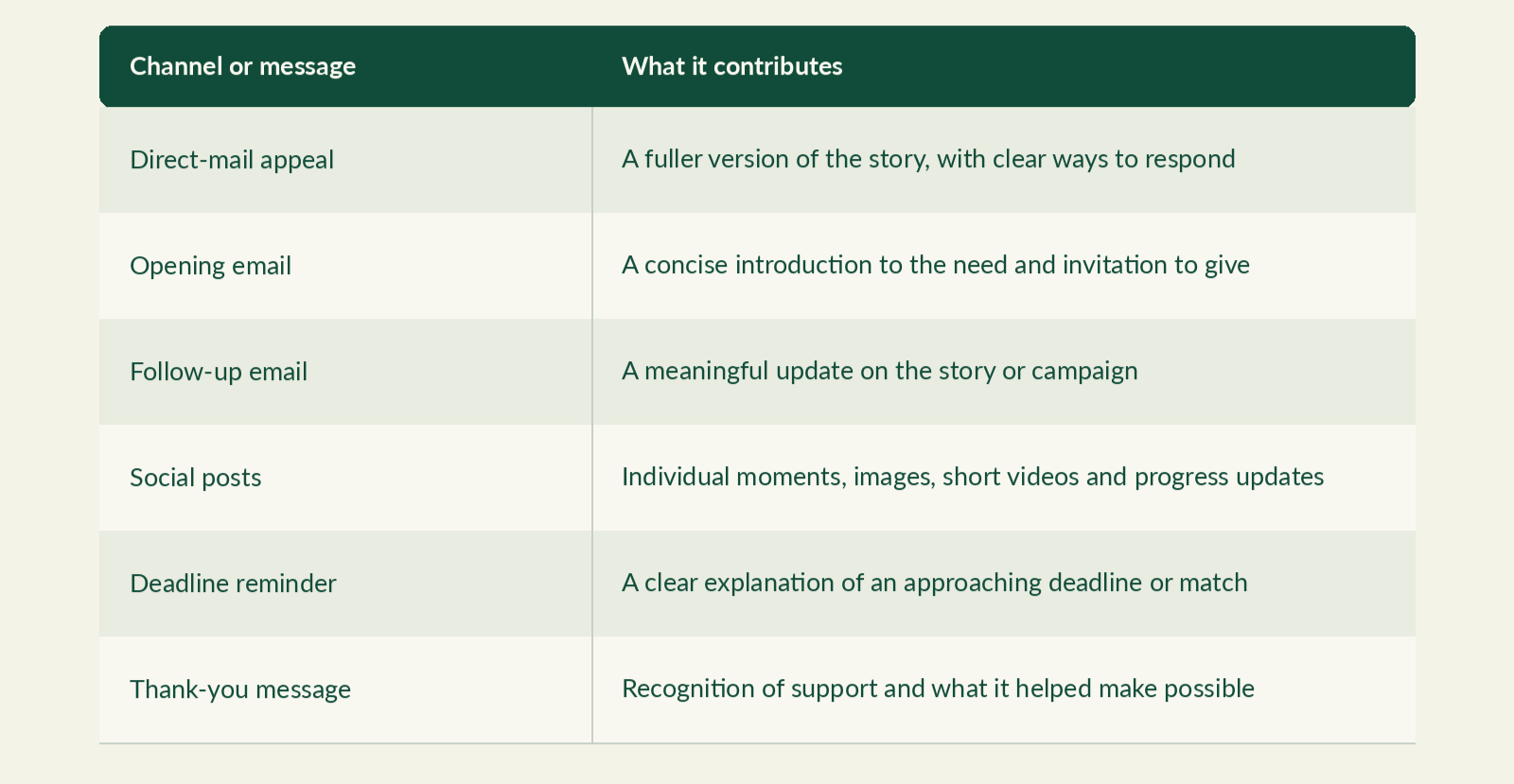
You can also adjust the conversation for different supporters. Longtime donors do not need the same introduction as someone who has only recently discovered your work. Monthly donors may need a different invitation.
There is no universal number of messages that guarantees a donation. The practical takeaway is to avoid putting all the pressure on one email—and to make each additional communication useful.
12. Start with people already connected to your cause
During the Q&A, Daniel brought forward questions about finding suitable donors and choosing between broad outreach and targeted campaigns.
Jena encouraged organizations to examine who already has a natural connection to the work: event attendees, volunteers, engaged followers, people with a personal connection to the cause and the networks of board members and current supporters.
“Who is already one or two degrees away from us, and then how do we invite them closer?”
— Jena Lynch
For a small organization, this can be a manageable starting point. Look at what connects existing supporters, where others with similar interests spend time and who might be willing to make an introduction.
Daniel also highlighted partnerships as a way to reach relevant audiences. Businesses, community organizations, creators and other advocates can help share a campaign and explain why it matters to their communities.
A shared cause and clear message help people understand the connection between the partners and the work.
Giving Tuesday can open a longer conversation
Jena encouraged attendees to see Giving Tuesday as part of a wider year-end effort.
“Giving Tuesday is not the end-all, be-all.”
— Jena Lynch
A campaign with a defined beginning and end can give supporters a clear goal to work toward. Updates can show progress, explain what remains to be done and give existing supporters something useful to share.
Before the campaign begins, make time to reconnect. Share the work, acknowledge previous support and explain what is ahead. After it ends, close the loop with a thank-you and an update.
That complete experience helps supporters understand their contribution beyond the moment they click “donate.”
A resource worth exploring: Donorbox
We appreciate Donorbox’s partnership with The Good Growth Company and Jena’s contribution to this session.
For organizations reviewing their fundraising tools and looking for practical guidance, we recommend exploring Donorbox. During the session, Jena discussed ways fundraising pages, campaign updates and simple giving pathways can support the communications work behind an appeal.
She also highlighted Donorbox’s educational resources, including a Giving Tuesday appeal handbook with examples from real organizations. These can provide a useful starting point as your team develops its own approach.
As Jena emphasized, technology works best when strong practices sit behind it: a clear case for support, a truthful story, an understandable ask and ongoing attention to donor relationships.
The Good Growth Company helps nonprofits and purpose-driven organizations invest in their people through practical training, consulting and shared learning. Explore our resources and upcoming sessions to help your team build skills and scale its mission.